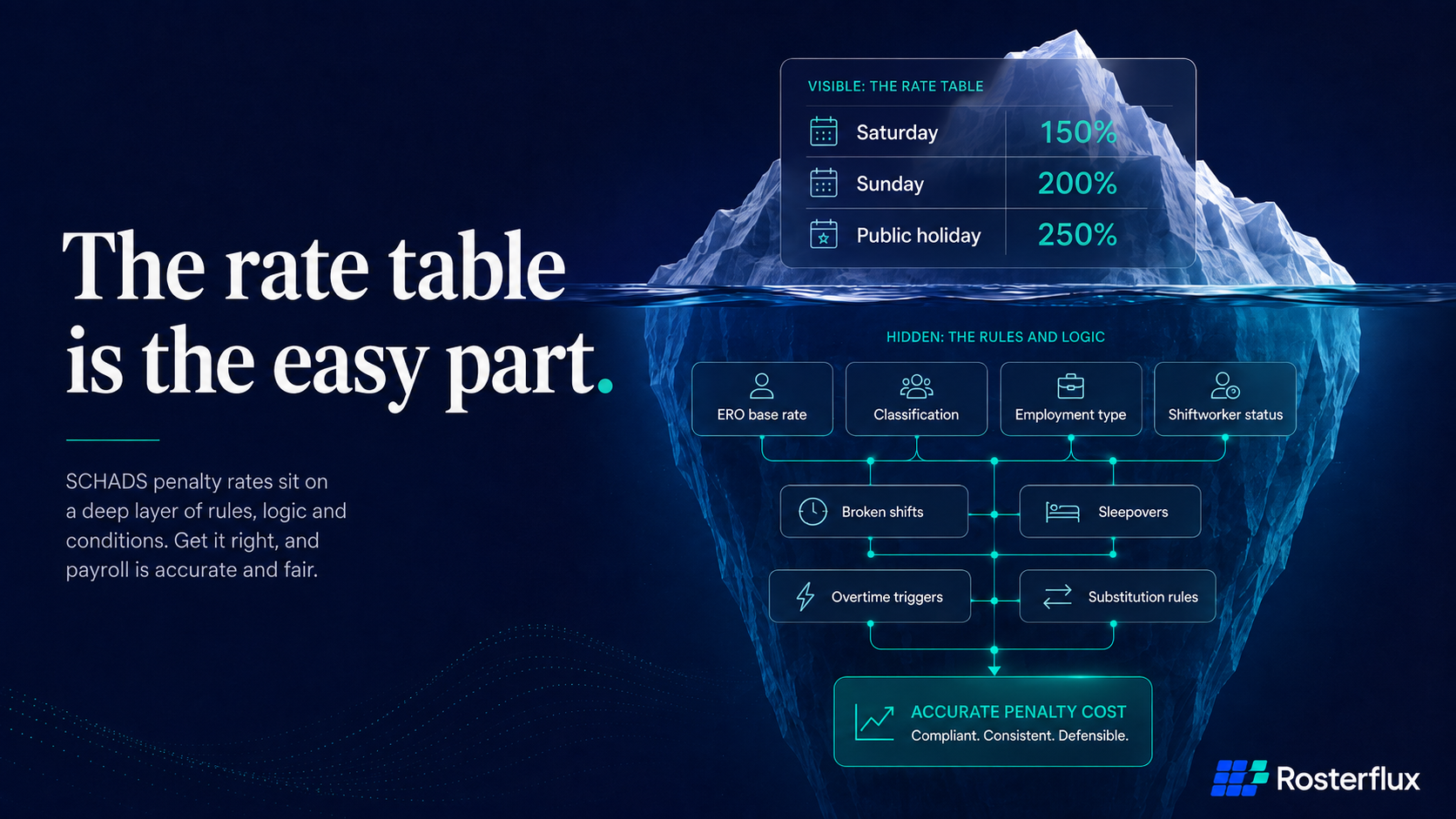
Most SCHADS articles give you a table of percentages. The table is the easy part. What causes underpayments, overpayments and margin leaks is the set of rules that decide which rate applies to which hours, and those rules are not intuitive.
Here are the seven that break payroll most often, with worked examples at the rates that apply from the first full pay period starting on or after 1 July 2026.
This is general information about how the award reads, not legal or industrial advice. Figures come from the Fair Work Commission's consolidated award, not from a summary.
One thing worth stating up front for agency readers: SCHADS covers labour hire businesses and their employees placed with organisations in these sectors. If you place support workers, home care workers or crisis accommodation staff, these are your rules, not only your client's.
First, the rate almost everyone gets wrong
Before any penalty applies, you need the right base. And for most social and community services employees, the base is not the minimum wage in clause 15.
An equal remuneration order (PR525485) applies to employees in the SACS and crisis accommodation classification schedules. The award states directly that the ERO's "current hourly wage" and "current weekly wage" form employees' ordinary rates of pay for all purposes. Not a top-up, not an allowance. The ordinary rate.
For applicable SACS employees at pay point 1:
| Classification | Clause 15 minimum | ERO % | Current weekly rate | Ordinary hourly rate |
|---|---|---|---|---|
| SACS Level 1 pp1 | $1,046.90 | n/a | $1,046.90 | $27.55 |
| SACS Level 2 pp1 | $1,119.10 | 123% | $1,376.49 | $36.22 |
| SACS Level 3 pp1 | $1,221.10 | 126% | $1,538.59 | $40.49 |
| SACS Level 4 pp1 | $1,344.50 | 132% | $1,774.74 | $46.70 |
The equal remuneration order does not reach Level 1, so Level 1 sits at the clause 15 minimum. Across Levels 2 to 4 shown here, the payable ERO rate is 23% to 32% above the clause 15 minimum. The gap widens further up the scale: 37% at Level 5, 40% at Level 6, 42% at Level 7 and 45% at Level 8.
If your system uses the clause 15 minimum as the employee's ordinary rate, every penalty and every overtime calculation built on that rate is understated, and it compounds through the entire pay run.
Allowances need testing separately. The wage-related allowances discussed below do not move with an individual employee's ERO rate: they are calculated from the standard rate, which clause 3.1 defines as the minimum wage for a SACS Level 3 pay point 3 employee, currently $1,283.10. That is a clause 15 figure, not an ERO figure. So the sleepover and broken-shift allowances below are the same dollar amount for a Level 2 employee as for a Level 8 employee, and fixing your base rates will not move them.
That is rule zero. Now the seven.
The penalty rates, so we have something to work with
| Ordinary hours worked | Full-time and part-time | Casual (inclusive of the loading) |
|---|---|---|
| Monday to Friday, within the span | 100% | 125% |
| Saturday | 150% | 175% |
| Sunday | 200% | 225% |
| Public holiday | 250% | 275% |
Afternoon and night shift loadings sit separately. Their definitions are Monday to Friday, and they apply to employees engaged as shiftworkers under clause 29. A day worker whose ordinary span is 6:00am to 8:00pm does not pick up a shift loading by working outside it: that is an overtime question instead.
| Shift type (shiftworkers, Mon-Fri) | Definition | Full-time and part-time | Casual |
|---|---|---|---|
| Afternoon shift | Finishes after 8:00pm and at or before midnight | 112.5% | 137.5% |
| Night shift | Finishes after midnight, or commences before 6:00am | 115% | 140% |
Those are ordinary-hours shiftwork rates. The weekend, public holiday and overtime substitution rules still govern, and as rule 2 explains, they displace these loadings rather than adding to them.
One note on the casual column. The award states casual composites for weekends (cl 26.4) and public holidays (cl 34.2(d)) but not for shiftwork. The figures above are the additive composition of the 25% casual loading in clause 10.4 and the 12.5% or 15% shift loading in clause 29.3, which is the same construction the award uses explicitly for weekends.
The award defines a public holiday shift too, but that definition is not restricted to Monday to Friday and it lands on the same result as the 250% row above, so it is left out here rather than described twice in two different conventions.
Overtime is a separate regime again, and it differs by employee stream. More on that in rule 7.
1. The shift loading usually turns on when the shift finishes, but an early start also creates a night shift
Under SCHADS, an afternoon shift is one that finishes after 8:00pm and at or before midnight. A night shift is one that finishes after midnight or commences before 6:00am. Both definitions apply Monday to Friday only.
So the finishing time is what you check first, but it is not the only limb. For a continuous Monday-to-Friday shift worked by an employee engaged as a shiftworker, a 5:30am commencement creates a night shift regardless of when it finishes.
Under the Aged Care Award (MA000018), the equivalent allowances work the other way: they are set by the commencing time, in bands. A shift commencing from 1:00pm and before 4:00pm attracts 12.5% regardless of when it finishes.
Take a single 3:00pm to 8:00pm shift on a Tuesday:
- Under SCHADS: it finishes at 8:00pm, not after it. No afternoon loading.
- Under Aged Care: it commences at 3:00pm, inside the 1:00pm to 4:00pm band. 12.5% loading.
Extend the SCHADS shift by thirty minutes to 8:30pm and the 12.5% now applies, to all five and a half hours. Identical work, and the loading turns on a half hour at the end that most rostering conversations treat as a rounding detail.
If your agency staffs aged care facilities and disability services from the same roster, you cannot carry one mental model across both.
2. Weekend and public holiday rates are in substitution for the shift loading, not on top of it
This is not a "greater of" comparison, and getting the reasoning right matters as much as getting the number right.
Clause 26.2 says the Saturday and Sunday rates are in substitution for and not cumulative upon the shift premiums. Clause 34.2(b) says the public holiday rate is instead of any shift or weekend rate that would otherwise apply. And because the afternoon and night shift definitions are expressed as Monday to Friday, on a weekend there is usually no shift loading in play to begin with.
Worked example. Full-time SACS Level 2 pp1 at $36.22, Saturday 2:00pm to 9:30pm, 7.5 ordinary hours.
- Correct, Saturday at 150%: 7.5 x $36.22 x 1.50 = $407.48
- Adding a 12.5% loading on top (162.5%): 7.5 x $36.22 x 1.625 = $441.43
- Multiplying the two (168.75%): 7.5 x $36.22 x 1.6875 = $458.41
That is $33.95 or $50.93 overpaid on one shift. Across a weekend roster of forty support workers it is real money, and unlike an underpayment it is far less likely to be raised by an employee.
3. For ordinary weekend and public holiday hours, casual loading is additive, not multiplicative
The award sets the casual weekend and public holiday rates directly, and they are inclusive of the casual loading: 175% on Saturday, 225% on Sunday, 275% on a public holiday. Those are the permanent rates plus 25 percentage points, not the permanent rates multiplied by 1.25.
Worked example. Casual SACS Level 2 pp1 at $36.22, Sunday 9:00am to 4:30pm, 7.5 hours.
- Correct, 225%: 7.5 x $36.22 x 2.25 = $611.21
- Multiplying 1.25 by 2.00 to get 250%: 7.5 x $36.22 x 2.50 = $679.13
$67.92 overpaid on a single Sunday shift. This one is almost always a spreadsheet formula that multiplies a casual flag through the penalty column instead of adding to it.
Do not generalise the rule to overtime. Clause 28.1(b) sets the casual overtime rates directly, and they are not the permanent overtime rate plus 25 percentage points.
4. On a continuous shift the loading applies to the whole shift, but broken shifts and sleepovers are tested piece by piece
For an ordinary continuous shift, the award is explicit: an afternoon or night shift loading is paid "for the whole of such shift". It is not apportioned to the hours after 8:00pm or after midnight.
That produces results that look wrong until you see the rule. A 5:30am to 1:30pm weekday shift commences before 6:00am, so for a shiftworker it is a night shift, and all eight hours carry 15% even though seven and a half of them are in broad daylight.
Worked example. Full-time SACS Level 2 pp1 shiftworker at $36.22, Monday 5:30am to 1:30pm, 8 ordinary hours. (A day worker rostered on those hours is a different question entirely: 5:30am is outside the 6:00am to 8:00pm span, so it goes to overtime, not to a loading.)
- With the night loading: 8 x $36.22 x 1.15 = $333.22
- Paid flat: 8 x $36.22 = $289.76
$43.46 per shift, and it gets missed for months because the shift does not feel like a night shift.
Two exceptions matter. The first has been in the award since July 2022; the second arrived in June 2026.
Broken shifts are assessed per period of work. Each period in a broken shift is tested against the afternoon and night definitions separately, and the award adds a specific carve-out: the night shift allowance is not payable for a broken-shift period that commences before 6:00am. The award's own example is a broken shift of 9:00am to 11:00am and 5:30pm to 8:30pm, where the afternoon loading is payable on the second period only.
Work either side of a sleepover is treated separately. Since 1 June 2026, where an employee is rostered immediately before and immediately after a sleepover, the two portions are assessed separately for shift loading purposes. The award's example: 9:00pm to 11:00pm before the sleepover and 7:00am to 11:00am after it, and the afternoon loading is payable on the first period only.
So "the whole shift" is the rule for a continuous block of hours. The moment the shift is broken or wrapped around a sleepover, you are back to testing each piece.
5. Sleepovers pay an allowance, and work during one is paid at the overtime rate
A sleepover is a continuous span of 8 hours, and it attracts an allowance of 4.9% of the standard rate, currently $62.87.
Three details that get lost:
- Work during the sleepover is paid at the prescribed overtime rate, with a minimum payment as for one hour worked. Not the ordinary rate, and not the shift rate. If the worker is woken for twenty minutes, that is an hour at overtime rates.
- At least four hours must be rostered or paid for at least one of the periods immediately before or after the sleepover, and the sleepover allowance is in addition to that minimum payment.
- Since 1 June 2026, an employer and employee may agree to ordinary hours of up to 12 hours per shift where part is worked immediately before and part immediately after a sleepover, with a maximum of eight ordinary hours on either side.
The failure mode we see most is paying the 8-hour sleepover span as ordinary hours. Eight hours at $36.22 is $289.76 against an allowance of $62.87 for the same span. Note carefully what is being compared: the allowance covers the sleepover span itself, and the rostered work before and after it, and any wake-up work during it, are all paid separately on top. Getting that distinction wrong in either direction is expensive.
6. Broken-shift allowances are per shift, only apply to some employees, and the 12-hour span has teeth
The broken-shift provisions apply only to social and community services employees undertaking disability services work, and to home care employees. If you apply them more widely, you are paying an allowance the award does not require.
| Broken shift | Allowance |
|---|---|
| 2 periods of work with 1 unpaid break | $21.81 (1.7% of the standard rate) |
| 3 periods of work with 2 unpaid breaks, by agreement | $28.87 (2.25% of the standard rate) |
Three things to get right.
The allowance is per broken shift, not per break and not per day. The two-break version also requires agreement before each occasion, unless it is part of an agreed regular pattern of work.
The span is where the money is. A broken shift may span up to 12 hours, and all work performed beyond a 12-hour span is paid at double time. A 7:00am start and a 7:30pm finish is a 12.5-hour span, and that last half hour is not ordinary time.
And the system has to represent the actual roster arrangement. Recording one broken shift as two unrelated shifts can suppress the allowance, apply the wrong minimum-engagement rules, and hide the 12-hour span test. This is not a configuration choice with two defensible answers: there is a fact about how the employee was rostered, and the record has to match it.
7. Overtime depends on employment type and employee stream, and daylight saving is usually paid by the clock
There is no 7.6-hour daily overtime threshold in this award. That number is an artefact of dividing 38 by 5, and it does not appear in clause 28.
Ordinary hours are 38 per week, worked in shifts not exceeding eight hours, or up to 10 hours by agreement, or up to 12 hours by agreement in the sleepover arrangement described above. An eight-hour rostered shift can consist entirely of ordinary hours. It does not automatically contain 24 minutes of overtime merely because 38 divided by five is 7.6.
What actually triggers overtime:
| Who | Trigger | Rate |
|---|---|---|
| Full-time, disability services / home care / day care | Work beyond rostered ordinary hours, Mon-Sat | 150% first 2 hours, then 200% |
| Full-time, social and community services / crisis accommodation | Work beyond rostered ordinary hours, Mon-Sat | 150% first 3 hours, then 200% |
| Full-time day worker, disability services / home care / day care | Work outside the 6:00am to 8:00pm span, Mon-Sat | 150% first 2 hours, then 200% |
| Full-time day worker, social and community services / crisis accommodation | Work outside the 6:00am to 8:00pm span, Mon-Sat | 150% first 3 hours, then 200% |
| Any employee | Overtime on a Sunday | 200% |
| Any employee | Overtime on a public holiday | 250% |
| Part-time and casual | Beyond 38 hours per week or 76 per fortnight | 150% first 2 hours, then 200% |
| Part-time and casual | Beyond 10 hours per day or shift | 150% first 2 hours, then 200% |
| Part-time and casual | Beyond 12 hours on an agreed shift either side of a sleepover | 150% first 2 hours, then 200% |
| Part-time and casual day workers | Work outside the 6:00am to 8:00pm span | 150% first 2 hours, then 200% |
The part-time and casual percentages in that table are the applicable overtime rates as the award sets them. Do not add another 25 percentage points for a casual employee.
Two hours at 150% for a disability services employee, three hours for a social and community services employee, doing what may look like the same overtime.
The part-time and casual thresholds cut the other way too. Subject to the weekly and fortnightly limits, the day-worker span and the other clause 28 triggers, time up to the 10-hour or agreed 12-hour threshold is not overtime merely because it exceeds 7.6 or 8 hours. It stays ordinary time, and attracts the applicable ordinary-hours rate including casual loading and any weekend or public holiday penalty.
Overtime rates are also in substitution for shift premiums, and the weekend rates do not apply to overtime worked on a Saturday or Sunday. You do not stack them.
Then there is daylight saving, and the intuitive answer is wrong.
Consider a 10:00pm to 6:00am shift. When the clocks go back in April the employee is physically present for nine hours; when they go forward in October, seven.
It is tempting to conclude that April automatically generates an hour of overtime. Under the award alone, and absent a different enterprise agreement or contractual provision, it does not. Fair Work Ombudsman guidance is that unless the award, enterprise agreement or contract says otherwise, overnight employees are paid by the clock: they are paid their usual shift length either way. The SCHADS Award contains no daylight saving provision, so the default applies. In October the employee works seven hours and is paid for eight. In April they work nine and are paid for eight.
The trap is the reverse of what most people expect. A payroll system that pays raw elapsed duration with no daylight-saving override will produce nine hours in April and may generate overtime that is not payable. A system that stores times in UTC can still be right here, as long as its award engine deliberately applies the clock-time rule. Check what yours does before the first Sunday in April, not after.
And because Queensland, the Northern Territory and Western Australia do not observe daylight saving, a national agency can have both situations inside the same pay run on the same night.
The pattern underneath all seven
Every one of these is the same class of problem. The rate table is not the rule.
The rule is a small program: establish the correct ordinary rate, including the ERO where it applies; classify the employee's stream and employment type; work out whether the shift is continuous, broken, or wrapped around a sleepover; test each relevant period against the shift definitions; substitute rather than stack the competing penalties; then apply the overtime triggers that match that employee. Get the order wrong and you produce a number that looks plausible and is wrong, in one direction or the other, every pay run.
The inputs are not just a start time and a finish time. They include the employee's stream and classification, whether the ERO applies and at which pay point, the rostered ordinary hours, cumulative weekly and fortnightly hours, any agreed part-time pattern, broken-shift and sleepover status, the public holiday calendar for that jurisdiction, and whether an enterprise agreement displaces the award. That is the honest list.
Rosterflux brings award-aware costing into the roster itself, so applicable penalties, allowances and charge rates can be reviewed before the pay run rather than reconciled after it. Book a demo if you want to see it run against your own setup.
Rates and clause references in this article are drawn from the Fair Work Commission consolidated SCHADS Award (MA000100), incorporating variations up to and including 1 July 2026, and apply from the first full pay period starting on or after 1 July 2026. This is general information, not legal or industrial advice. Your obligations depend on the classification, employee stream, employment basis and any enterprise agreement that applies.